
Written by Johanna Frank
Business Advisor at OneLab
Preventing work-related ill health and injuries is a central part of an employer's responsibility. In workplaces where employees are exposed to particular work environment risks, there may also be requirements for medical checks or other health examinations.
Not all employees have the same tasks or face the same risks. That is why OneLab is now expanding its offering with examinations for specific work environments:
- Statutory medical checks, with or without a physician's certificate
- Hearing tests, eye tests and spirometry as add-ons to Health Examination Base and Plus
- Health Examination Construction, a new package for the construction industry based on the Swedish Construction Agreement (Byggavtalet)
By combining preventive health examinations with targeted checks, health work becomes better tailored to needs, taking into account employees' roles, tasks and exposures. At the same time, the employer gets a better basis for its ongoing work environment management. Read more about Health Examination Construction below.
Three different things that are easy to mix up
Medical checks, add-ons and Health Examination Construction can include similar elements, such as hearing or lung function. But they have different purposes, are governed by different rules and apply to different groups of employees.
Statutory medical checks are required under the regulations of the Swedish Work Environment Authority (Arbetsmiljöverket) when employees are exposed to certain risks at work, such as vibration, dust or chemical substances. They are a legal requirement for the employer and apply only to employees whose tasks involve the exposure in question.
Add-ons for hearing, vision and spirometry are voluntary examinations that any company, regardless of industry, can add to its health examinations. They are a good fit when the employer wants a better overview of employees' hearing, vision or lung function, without there being a requirement for a medical check.
Health Examination Construction is designed on the basis of the Construction Agreement (Byggavtalet), the collective agreement between the Swedish Construction Federation (Byggföretagen) and the Swedish Building Workers' Union (Byggnads). It is not a legal requirement from the Swedish Work Environment Authority, but something that employers covered by the agreement must offer to all their employees to whom the agreement applies.
What is a statutory medical check?
A medical check is an examination of an employee's health carried out because of a risk in the work environment. Its purposes include detecting early signs of work-related ill health and preventing existing problems from getting worse.
It is the employer's responsibility to investigate and assess the risks in the workplace and to arrange the checks that the regulations require. Which employees are covered and how often the checks must be carried out depends on the nature of the work, the size and duration of the exposure, individual risk factors and the outcome of the employer's risk assessment. This is set out in the Swedish Work Environment Authority's guidance on medical checks and health examinations in working life. The checks required for different exposures are set out in the Swedish Work Environment Authority's regulations AFS 2023:15.
A medical check is carried out by a physician with specific expertise in the exposure in question. For work with vibrating tools, for example, the physician examines sensation, circulation, reflexes and grip strength in the hands, among other things, and makes an assessment directly on site. Sometimes the check itself is sufficient; in other cases a physician's certificate is also required. OneLab offers medical checks both with and without a physician's certificate, depending on what the business needs.
Medical checks do not replace measures in the work environment. Instead, the results should help the employer identify risks, review working methods and take preventive action.
Add-ons for hearing, vision and lung function
Hearing tests, eye tests and spirometry can be added to OneLab's Health Examination Base and Plus. The add-ons are voluntary and suit any organisation that wants to pick up early signs of problems, regardless of industry.
Hearing test
Hearing loss can develop gradually and be difficult to detect at an early stage. That is why regular hearing tests are especially valuable in workplaces with noisy environments.
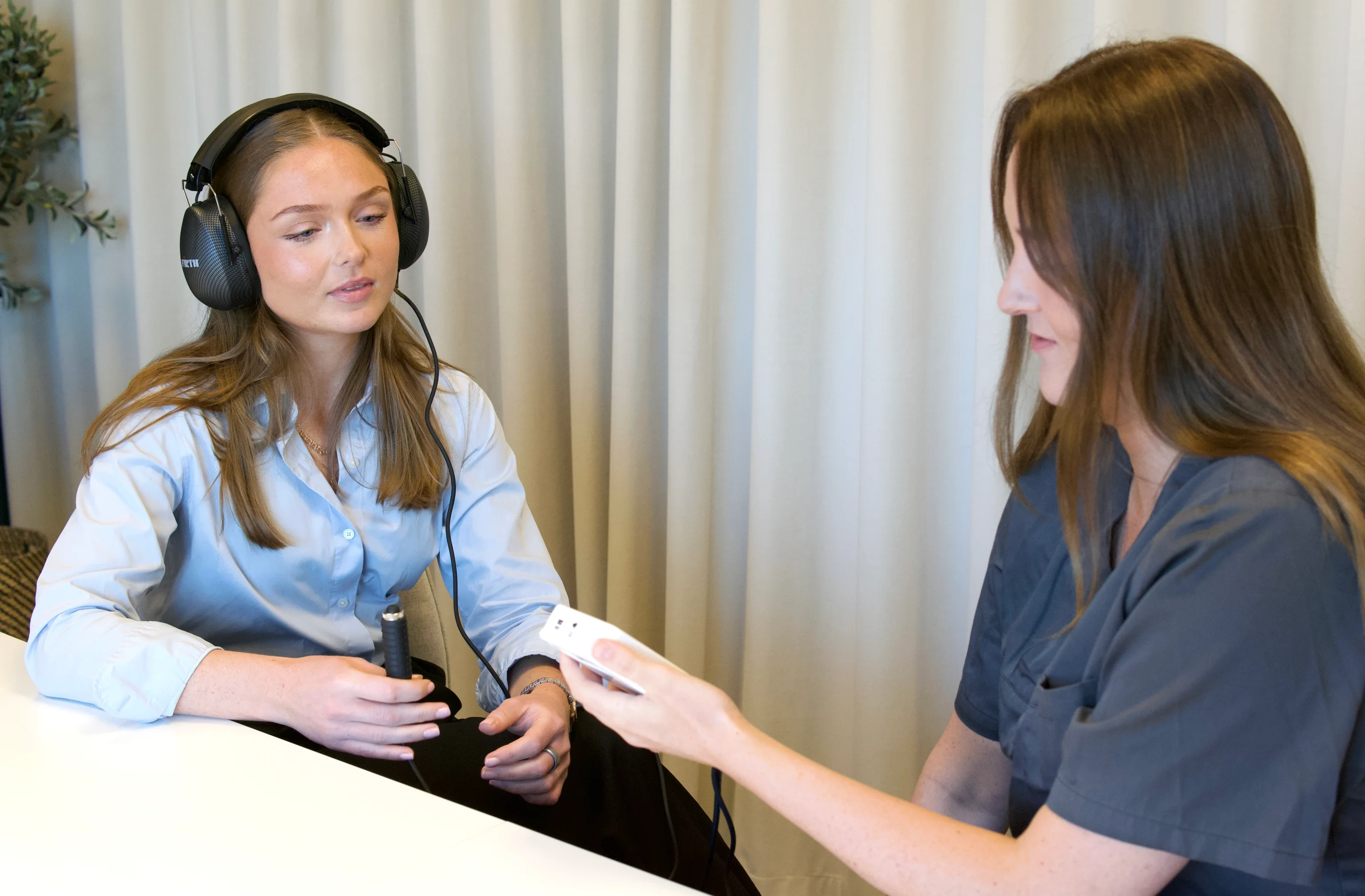
OneLab offers hearing tests directly at the workplace. The test is painless and shows how the employee perceives different tones and sound levels. The result can give an early indication of hearing loss and show whether further assessment is needed.
If noise exposure reaches certain levels and the risk assessment shows that there is a risk of hearing damage, the employer is obliged to offer a hearing test. The requirements are set out in the Swedish Work Environment Authority's regulations AFS 2023:10.
Eye test
An eye test measures the employee's vision to detect changes in vision early that could affect safety and work capacity. The test is a simple on-site screening, and if needed the employee receives a recommendation to visit an optician. When vision problems are detected early, preventive measures can be put in place, reducing the risk of strain-related problems and accidents at work.
Spirometry
Spirometry is a lung function test that measures how much air a person can breathe out and how quickly. The employee breathes in deeply and then blows out forcefully through a mouthpiece connected to a spirometer.
The test is used, among other things, to detect and monitor lung diseases such as asthma and COPD, and is particularly relevant in work environments where employees may be exposed to dust, smoke, gases or chemical substances. The result can show signs of reduced lung function and provide a basis for further medical assessment.
New for the construction industry: Health Examination Construction
The health risks in the construction industry differ from those in many other sectors. Noise, vibration, dust and physically demanding tasks affect health in different ways than, for example, office work. That is why we are launching Health Examination Construction, a package designed on the basis of the Construction Agreement and the work environment risks of the construction industry.
What does the Construction Agreement say?
The Construction Agreement (Byggavtalet) is the collective agreement between the Swedish Construction Federation (Byggföretagen) and the Swedish Building Workers' Union (Byggnads). Under the agreement, the employer must offer a health examination to all employees covered by the agreement, at least every three years up to the age of 49 and every year from the age of 50.
The agreement does not set detailed requirements for exactly what the examination must include, but it does give recommendations. These include ergonomics and musculoskeletal strain, vibration, a health profile covering lifestyle habits and work-related risk factors, mental health, respiratory health, skin and allergies, hearing and vision. OneLab's extended health examination for the construction industry covers all of these areas.
Source: Byggföretagen & Byggnads (2025). Byggavtalet 2025: Ett kollektivavtal mellan Byggföretagen och Byggnads, 2025-05-01–2027-04-30. Digital edition 1.
What is included in Health Examination Construction?
Health Examination Construction is based on OneLab's Health Examination Base or Plus and is complemented with construction-specific examinations and screenings:
- Hearing test
- Eye test
- Spirometry (lung function)
- Screening for symptoms of vibration injuries
- Screening for allergies and skin problems
- Assessment of fitness and physical function
- Screening for musculoskeletal problems
The construction-specific part is combined with OneLab's broad health assessment. This consists of blood tests for markers such as long-term blood sugar and blood lipids, blood pressure and questions about lifestyle habits, sleep, stress and mental health. In this way, the examination captures both the risks that come with the work and other factors that affect the employee's health over time, such as the risk of cardiovascular disease and diabetes.
The digital screening is based on dynamic questions that adapt to previous answers. Employees only answer questions that are relevant to them, which gives a more accurate basis for the medical assessment. The examination is carried out directly at the workplace.
Vibration screening is not the same as a medical check
It is important to keep the concepts apart here. Health Examination Construction includes a screening with questions about exposure and symptoms related to sensation, circulation and hand function. It does not replace the statutory medical check for vibration exposure, in which a physician carries out a clinical examination.
Health Examination Construction can, however, help the employer see where the need exists. If the screening shows signs of problems, this can be a basis for carrying out medical checks for the employees concerned. The employer makes that decision based on its risk assessment, and OneLab can also carry out those checks.
Results the employee understands
Byggnads highlights follow-up of results as a necessary part of preventive occupational health care. Results should be communicated in a way that is understandable even to someone without medical knowledge.
After the examination, each employee receives their results presented in a clear and accessible way, together with an individual medical assessment. Employees have access to personal health advice and counselling via video calls and chat in the app, with OneLab's medical team of physicians and nurses. If something needs to be followed up, the employee receives recommendations and can be referred onwards if needed.
At group level, the results are compiled so that the employer can see shared risks, patterns and needs in the organisation. This provides a concrete basis for prioritising initiatives in the systematic work environment management.
Part of preventive work environment management
Targeted examinations for specific work environments are ultimately about detecting work-related ill health early and giving the employer better conditions to act.
With OneLab's expanded offering, employers can bring statutory medical checks, voluntary add-ons for hearing, vision and lung function, and Health Examination Construction together with one partner. The examinations are carried out at the workplace, which reduces administration and makes it easier for employees to take part.
Which checks a workplace needs must always be decided on the basis of the organisation's risk assessment and the requirements that apply to the exposure in question.
Would you like to know more about our new add-ons, medical checks or Health Examination Construction? Get in touch and we will help you find the right solution for your organisation's needs.
Contact usFill in your details and we will get back to you.
Frequently asked questions about statutory medical checks
What is a statutory medical check?
Who is responsible for making sure medical checks are carried out?
What is the difference between medical checks, add-ons and Health Examination Construction?
What is Health Examination Construction?
How often must a health examination be offered under the Construction Agreement?
Does Health Examination Construction replace statutory medical checks?
What is the difference between a medical check and a health examination?