
Written by Johanna Frank
Business Advisor at OneLab
Many companies today offer health examinations as an employee benefit and as part of their preventive work environment efforts. The ambition is a good one: to detect risks early, strengthen employee health and reduce future sick leave.
But there is a problem that is rarely discussed.
Samples are taken. Results are sent out. The employee receives a few numbers and perhaps a short comment in a report or an app. After that, the individual is expected to understand on their own what the results mean, how serious the risks are and which changes are actually needed.
That is why many traditional health examinations have limited effect. A health examination without follow-up risks becoming exactly that: a benefit without any real change.
Karolinska Institutet: follow-up is what makes the difference
In an extensive report (in Swedish), Karolinska Institutet compiled the evidence from 17 reviews and a total of 497 original studies on the effects of workplace health examinations, both with and without follow-up interventions.
The conclusion is clear: the real effect only occurs when the health check is combined with structured follow-up and support over time.
At the same time, the report points out that traditional health examinations without active follow-up lack support when it comes to long-term effect.
It is actually quite logical, says OneLab physician Andreas Lundin.
– Finding out that your blood pressure is elevated, that your stress level is high or that your sleep is affecting your recovery does not automatically lead to change.
On the contrary, the results often raise more questions:
- How serious is this?
- What does it mean for me in the long term?
- What should I prioritise first?
- Which changes actually make a difference?
- How do I know I am on the right track?
This is where a health examination with follow-up becomes crucial.
Why health checks without follow-up lack support in research
Many health checks are still designed as administrative screening processes rather than long-term health interventions.
The process often looks like this:
- Forms are filled in
- Samples are taken
- Results are sent out, in some cases with a follow-up meeting
- The process ends
The problem is that information on its own rarely changes behaviour. This is especially true in areas such as stress, sleep, physical activity, lifestyle habits and mental health.
A person who learns that certain values are elevated needs more than data. Changing your health usually takes more than just measurements.
It takes understanding, motivation, guidance and follow-up over time. Without continuous feedback, the health examination risks becoming yet another report that is quickly forgotten.
The findings of the report therefore show that health examinations without subsequent interventions are not recommended as a measure for improving health or health behaviours.
Health checks with physician follow-up: why they create greater peace of mind
One of the most important parts of a modern health examination is the opportunity for medical follow-up. A health check with physician follow-up means that the individual is not left alone with their results.
Instead, the person gets the chance to understand their test results in the right medical context, ask questions about them and follow changes over time.
For many people, it is precisely the conversation with a healthcare professional that makes the results actually lead to action. It creates both greater peace of mind and better conditions for long-term change.
That is also why more and more employers are asking for health checks with follow-up instead of simpler screening solutions.
What is a health examination with follow-up?
A health examination with follow-up means that the process does not end when the test results are ready.
Instead, the results are used as a starting point for continued support, dialogue and guidance.
This can include, for example:
- medical feedback on test results and health data
- a conversation with a physician or nurse
- help understanding individual risk factors
- recommendations tailored to the individual's situation
- support with stress, sleep, recovery and lifestyle
- follow-up over time
- clear next steps and concrete actions
The difference may sound small on paper, but in practice it is decisive.
For most people, the problem is not a lack of information. The problem is knowing what the information means, what is most important to act on and how to actually make changes in everyday life.
That is why a health examination with follow-up delivers considerably more value in the workplace than a traditional health check without feedback.
Finding out that your blood pressure is elevated, that your stress level is high or that your sleep is affecting your recovery does not automatically lead to change.
 Andreas Lundin
Specialist in General Medicine, OneLab
Why OneLab has built its health examination around follow-up
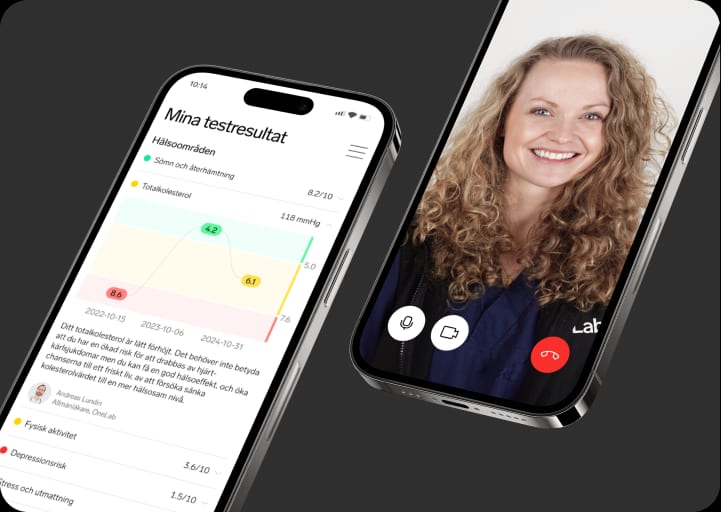
At OneLab, we do not see the health examination as a one-off effort. We see it as the beginning of long-term health work. That is why follow-up is a central part of our health examinations and is always included in our health packages.
Among other things, this means:
- medical feedback on the results
- contact with a physician or nurse when needed
- individually tailored recommendations
- clear next steps
- conversational support
- digital follow-up over time
- support with lifestyle-related risk factors
The focus is not only on identifying potential risks. The focus is on helping the individual understand the results and create real change over time.
Read more about our health examinations
What does this mean for employers?
For employers, the question is becoming increasingly important.
If the goal is to improve health, reduce sickness absence and work preventively in the long term, screening alone is rarely enough.
It is only when the results are followed up that the health examination becomes a tool for real change.
A health examination with follow-up can contribute to:
- earlier detection of health risks
- greater understanding among employees
- better conditions for lifestyle changes
- reduced risk of long-term ill health and sick leave
- greater peace of mind and engagement
- more long-term health work in the workplace
And perhaps most importantly of all:
It signals that health is not only about measuring values, but about actually taking care of the people behind them.
Frequently asked questions about health examinations with follow-up
What is the difference between a standard health examination and one with follow-up?
What is meant by follow-up?
Can employers offer health examinations with follow-up?
Who benefits from a health examination with follow-up?
Will I find out straight away if something is abnormal in a health examination?
How often should you have a health examination?