
Written by Johanna Frank
Business Advisor at OneLab
Mental ill health is one of Sweden's biggest work environment challenges. Stress, sleep problems, worry and low mood affect people in every industry and occupational group. But our picture of the problems is largely based on what is visible, reported and captured.
That makes the question of men's mental health particularly important. Men generally report lower levels of mental ill health than women, but that does not automatically mean the need for support is smaller. It may also be about how problems are expressed, interpreted and detected at work.
To mark International Men's Health Week, we therefore take a closer look at men's mental health at work: what the statistics show, what they risk missing and what employers need to understand to provide the right support in time.
The statistics on mental ill health show a clear gender difference
Since 2014, mental ill health has been the most common reason for sick leave in Sweden. In 2025, there were around 85,000 ongoing sickness cases with a psychiatric diagnosis, compared with 30,000 in 2010. Psychiatric diagnoses now account for 46 per cent of all sickness cases in the country.
When mental ill health at work is measured and followed up, a clear gender pattern emerges. Women are more often on sick leave for stress-related mental ill health, report stress and anxiety to a greater extent and seek help more often. According to the latest status report on mental ill health in today's working life from the Swedish Social Insurance Agency (Försäkringskassan), women accounted for 79 per cent of ongoing sickness cases for stress-related mental ill health in September 2025.
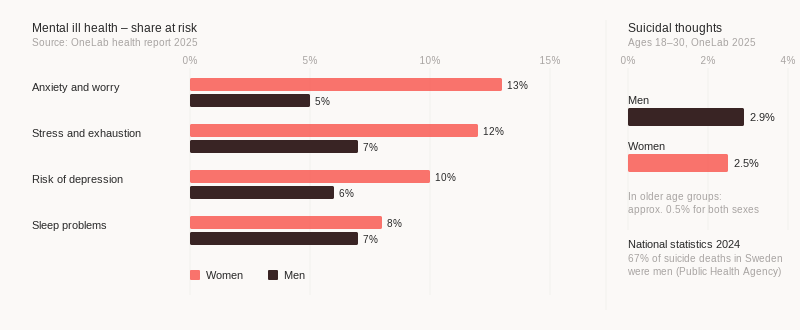
The same pattern can be seen in OneLab's health report, based on data from over 1,000 Swedish companies. Women consistently report higher levels of mental ill health: anxiety and worry, stress and exhaustion, risk of depression and sleep problems are all more common among female employees.
At the same time, the difference raises an important question for employers: what happens to the mental ill health that is not reported, not recognised or not detected in time?
When men's mental ill health goes undetected
The statistics mainly show mental ill health that has already become visible: through sick leave, contact with healthcare, survey responses or conversations with managers and HR. They say less about problems that are not described as mental ill health, that do not lead to contact with healthcare or that are never picked up in the workplace.
Lower reporting among men therefore needs to be interpreted with caution. The fact that men are less visible in many measurements does not necessarily mean that the need for support is smaller. At the same time, suicide statistics from the Public Health Agency of Sweden (Folkhälsomyndigheten) show that two thirds of those who died by confirmed suicide in Sweden in 2024 were men.
Most suicides occurred among men aged 45–64. This is also a stage of life when many are in the middle of their working lives, which makes early detection and support in the workplace particularly important. It underlines why employers cannot assume that an absence of signals is the same as an absence of mental ill health.
Mental ill health does not always reach the employer
The fact that mental ill health affects someone's ability to work does not mean the employer finds out. In a Nordic survey conducted by Kantar Media on behalf of ERGO, 18.8 per cent of Swedes said they would not tell their employer about mental ill health affecting their ability to work. A further 12.8 per cent were unsure.
This leaves the manager with an incomplete picture of the team. An employee can keep delivering, take part in meetings and answer "I'm fine" at a check-in, while stress, sleep problems or low mood are affecting their everyday life.
That is why it is not enough to wait for employees to raise the issue themselves. Employers need to build several routes to support: through present managers, recurring health follow-ups and the opportunity to take a first step without having to put everything into words in a conversation with a manager. For some, the manager is the natural way in. Others need a more independent first step.
Preventing mental ill health in the workplace
International Men's Health Week is a reminder that men's health is not only about physical health, lifestyle habits and medical check-ups. It is also about stress, sleep, worry, low mood, loneliness and suicidal thoughts.
The fact that few men talk about mental ill health in a workplace does not necessarily mean that few men are struggling. It may just as well mean that the problems have not yet become visible. That is why preventive work needs to start long before ill health leads to sick leave.
For employers, it is about combining several approaches: present managers, regular health follow-ups and clear routes to support. The manager plays an important role in building trust, noticing changes and following up on how employees are doing. At the same time, support also needs to be accessible in other ways. For many, it can feel easier to start in a more neutral channel, for example through occupational health services or a digital health check.
Signs of mental ill health often appear gradually. They can show up as changes in behaviour, poorer sleep, persistent stress, lower energy or someone becoming more withdrawn. When employers regularly follow up on health and the work environment at group level, it becomes easier to spot recurring patterns early, while protecting individual privacy.
An absence of conversation is not the same as an absence of problems. When it comes to mental health, the most important signals can sometimes be precisely the ones that are never said out loud.
Frequently asked questions about mental ill health at work
What can employers do to detect mental ill health earlier?
Why is men's mental ill health not always visible in the statistics?
What role does the manager play in addressing mental ill health?
When should employers act?
How can OneLab help employers work preventively with mental health?