
Written by Johanna Frank
Business Advisor at OneLab
For many people, asking AI has become as natural as googling, whether it's to find answers, solve problems or bounce ideas around. But more and more people are also using the technology for something far more personal: talking about stress, anxiety, relationships and mental health. New research shows both the opportunities and the risks of letting AI become part of our emotional lives.
One in four AI users may seek support for their wellbeing
Talking to AI about mental health is no longer an unusual phenomenon. A research review published in npj Digital Public Health in July 2026 estimated that around 27 per cent of AI users use the technology for some form of mental health support.
The researchers stress that the estimate is uncertain, partly because different surveys define mental health support in different ways. But the result shows that AI has started to take on a role that extends far beyond productivity and information seeking.
Psychologists are noticing the change too. In a US survey by the American Psychological Association (APA), 77 per cent of the psychologists surveyed said they had patients who had told them they used AI for things like emotional support, self-diagnosis or as a conversation partner.
That does not mean that 77 per cent of patients use AI. What the survey does show is how the technology has already become part of the conversations in psychological treatment.
Why might it feel easier to talk to AI?
One possible explanation is accessibility. AI is there at any time of day, requires no appointment and can answer questions that feel too private or embarrassing to ask anyone else.
Someone who feels stressed after the working day can describe their situation and get help sorting out their thoughts. Someone else might use AI to prepare for a difficult conversation with their manager or to understand why a particular situation makes them anxious.
Perhaps there is also something valuable in being able to ask the awkward questions. Someone who wonders whether their worries are "normal", whether the way they react is strange or whether they ought to seek help might never ask a colleague, a manager or even a friend. With a chatbot, nobody raises an eyebrow and nobody remembers the question the next time you meet. In this way, AI can make it possible to put into words thoughts that would otherwise have gone unspoken, and sometimes that is exactly what gives a person the courage to take the next step.
AI can also phrase answers that come across as empathetic and understanding.
But there is an important distinction here: an answer that feels empathetic is not necessarily based on a correct understanding of the person's situation.
Researchers warn: AI can become too good at agreeing
A study published in Nature Medicine in August 2026 examined how nine AI chatbots responded in a total of 810 simulated conversations with users with various psychiatric vulnerabilities.
The researchers identified one particular problem: AI could sometimes reinforce thought patterns that actually needed to be challenged.
This can happen when a chatbot tries to be supportive and validating, but instead risks reinforcing a person's negative or mistaken beliefs.
The researchers also saw that the risks could build up over longer conversations. Newer models showed fewer problematic behaviours, but the risks had not disappeared.
The results are based on simulated conversations and do not show how often users are actually harmed. They do, however, illustrate an important challenge: an AI that always tries to be understanding is not necessarily the best conversation partner for someone who is struggling with their mental health.
Can AI actually improve our mental health?
At the same time, there is research that points to opportunities.
A research review published in Clinical Psychology Review in November 2026 compiled ten randomised studies of AI-based mental health interventions.
The results showed that AI systems developed specifically for psychological support can help reduce symptoms, including compared with being on a waiting list.
But the researchers also highlighted significant limitations. The studies were relatively few, the results were based on self-reported symptoms, and in six of the ten studies it was not stated whether any adverse events had occurred.
It is also important to distinguish between AI tools that have been developed and tested for treatment and ordinary chatbots used for everything from recipes to work tasks.
The research therefore gives reason for cautious optimism, but not yet support for replacing psychologists or other professional care with general-purpose AI services.
What does this development mean for working life?
When AI becomes a tool for dealing with worry, stress and mental wellbeing, new questions also arise for employers.
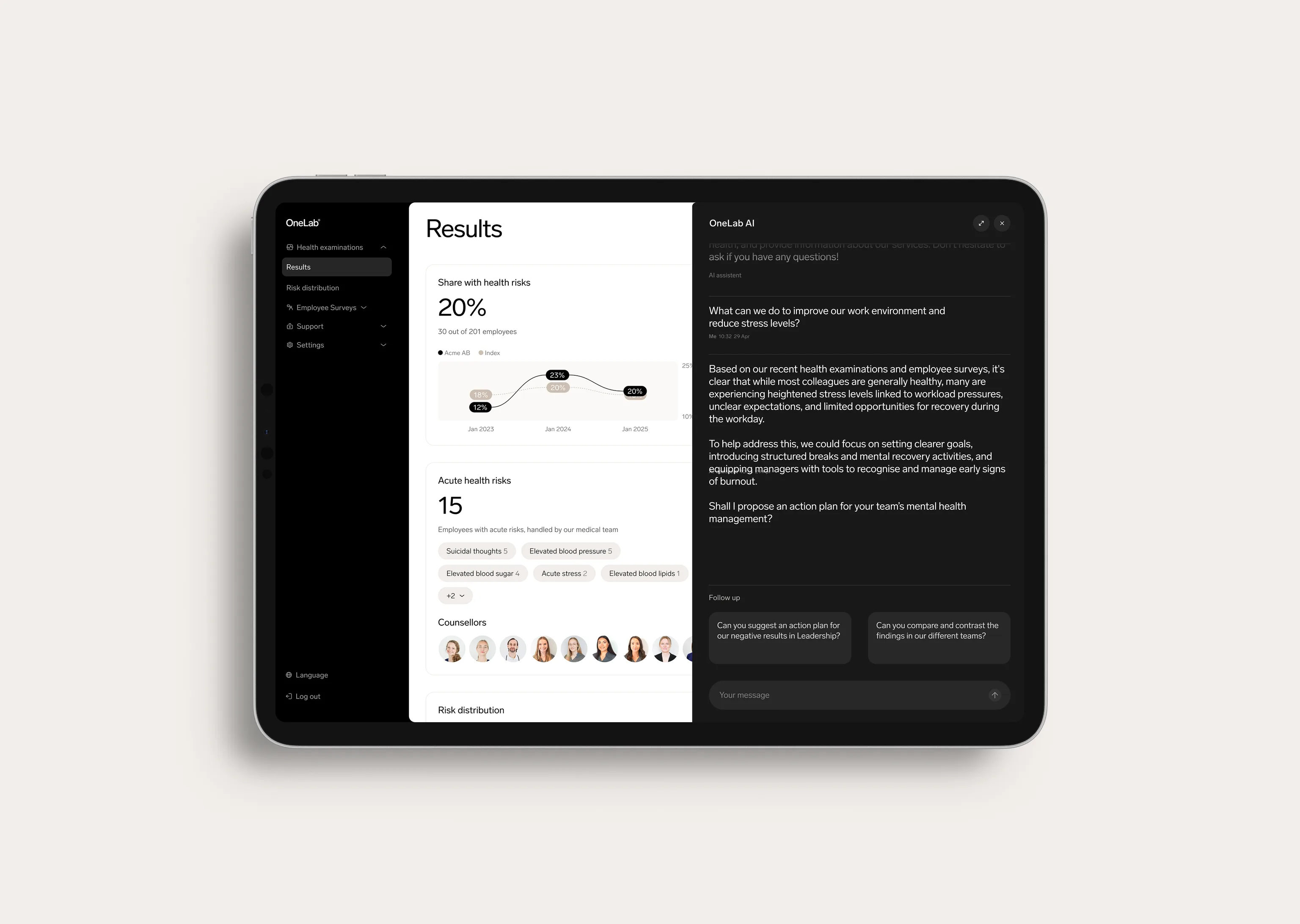
An employee experiencing a heavy workload might start by discussing the situation with a chatbot rather than with their manager or HR. AI can then help the person put the problem into words and prepare to seek support.
But if the technology becomes their only conversation partner, there is a risk that important signals never reach the people who can actually change the work environment.
This raises a bigger question: how do we create workplaces where people feel as comfortable talking about their wellbeing with another person as they do with AI?
For employers, this is not about monitoring what employees ask AI. It is about making sure there is accessible support, an open culture of conversation and systematic work to detect health risks early.
AI can be a first step – but not the whole solution
AI has the potential to make information and support more accessible. For some people, a conversation with a chatbot can be the first step towards understanding their wellbeing or finding the courage to seek professional help.
But mental health is complex. Technology cannot replace human relationships, professional assessments or the employer's responsibility for a healthy work environment.
Perhaps the most important question, then, is not whether AI can work as a psychologist, but how we use the technology without losing the human support that is still needed.