
Written by Johanna Frank
Business Advisor at OneLab
High cholesterol is rarely noticeable in everyday life, but over time it can contribute to cardiovascular disease. At the same time, a single cholesterol value does not tell the whole story about a person's risk. LDL, HDL, triglycerides, blood pressure, age, family history and other factors need to be weighed together. Here we explain what the different blood lipids mean, how test results are assessed and how employers can contribute to earlier detection without turning individual health data into an HR matter.
Cardiovascular disease was the most common cause of death in Sweden in 2025, according to the National Board of Health and Welfare's official cause-of-death statistics (Socialstyrelsen). That makes preventive work relevant, but it requires precision. An elevated cholesterol value is not a diagnosis, and a value within a normal reference range is no guarantee of low risk.
The most important principle is therefore simple: blood lipids must be interpreted in context. For the individual, this means an overall medical assessment. For the employer, it means providing access to examination, feedback and support, while the individual's results remain private.
What are cholesterol and blood lipids?
Blood lipids is a collective term for the fats transported in the blood. The two main groups are cholesterol and triglycerides. The body needs both. Cholesterol is used, among other things, when cells and hormones are formed, while triglycerides serve as an energy store. The problem arises when certain fat-carrying particles are present in excessive amounts or, over a long period, contribute to build-up in the artery wall.
This process is called atherosclerosis, or hardening of the arteries. It can make the arteries narrower and less elastic and increase the risk of, for example, heart attack and stroke. High blood lipids usually cause no symptoms and are therefore detected through blood tests, not by how a person feels.
LDL, HDL and triglycerides – what does the test show?
LDL cholesterol
LDL transports cholesterol out to the body's tissues. If the level is too high for a long time, cholesterol can be deposited in the artery wall. LDL is often called the "bad" cholesterol, but a more accurate way to view the value is as an important part of overall cardiovascular risk.
HDL cholesterol
HDL helps transport cholesterol away from the tissues and is therefore often called the "good" cholesterol. But a high HDL value cannot on its own offset an elevated LDL or other risk factors. HDL also needs to be interpreted as part of the whole picture.
Triglycerides
Triglycerides are blood lipids that the body mainly uses and stores as energy. Levels can be affected by alcohol, eating habits, weight, physical activity, diabetes and heredity, among other things. An elevated value therefore needs to be understood in relation to both the other test results and the employee's life situation and health.
Total cholesterol
Total cholesterol adds up the cholesterol in several different lipoproteins. It can give an initial overview, but on its own it does not show how the balance between LDL and HDL looks. Total cholesterol therefore needs to be read together with the other values and the person's overall risk profile.
A single cholesterol value cannot determine risk
There is no cholesterol value that can be assessed in the same way for everyone. At OneLab, a test result is not read as a standalone "pass" or "fail". Instead, our medical staff weigh the blood lipids together with other factors that affect the person's risk:
- age and biological sex
- blood pressure
- smoking and other nicotine use
- diabetes or elevated blood sugar
- kidney disease and other conditions
- previous cardiovascular disease
- family history of early cardiovascular disease or lipid disorders
- lifestyle habits and medicines that may affect the risk profile.
Two people with the same LDL value may therefore receive different assessments and different advice. For one, the result may be a minor deviation that is monitored over time. For the other, the same value, combined with, for example, family history or previous illness, may warrant faster follow-up. It is the overall picture that determines what the test result means for that particular person.
The test shows the value – the conversation determines what it means
A blood test can detect a deviation. But the test cannot on its own explain why the value is high, how great the risk is or what the person should do next. The same LDL value can be relatively undramatic for one person and considerably more significant for another. Without medical feedback, there is therefore a risk of both false reassurance and unnecessary worry.
It is in the conversation that the test result becomes understandable. Licensed healthcare professionals can take into account family history, previous illnesses, blood pressure, medicines, smoking, eating habits, physical activity and other circumstances that the laboratory value does not show. Only then is it possible to judge whether the result can be left without action, should be monitored over time or needs further investigation.
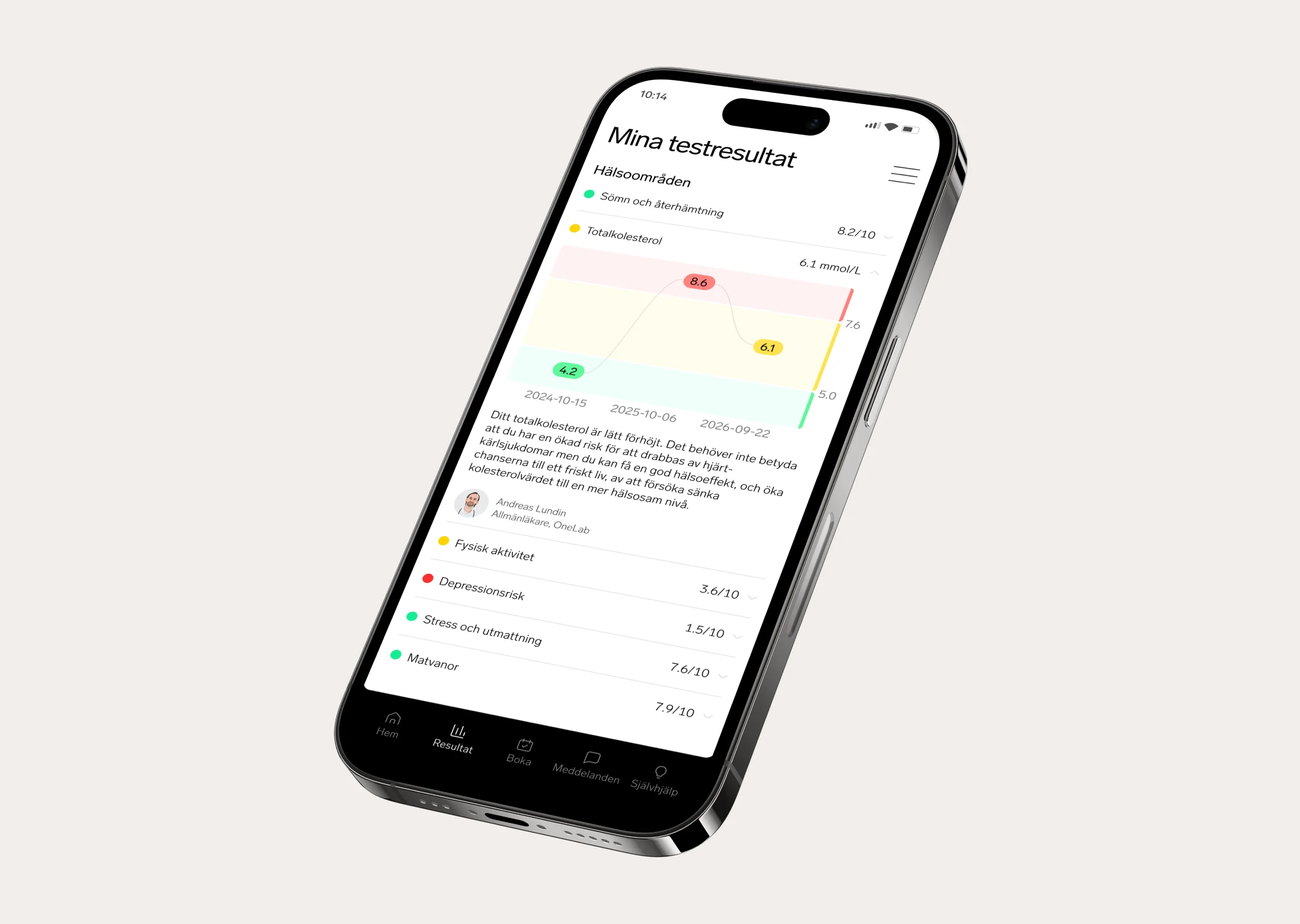
Individual feedback is not just recommended, but absolutely necessary for the test result to be interpreted correctly. In OneLab's health examinations, healthcare professionals review the results and go through other symptoms, medical history, family history, medicines and relevant lifestyle habits together with the employee to understand the whole picture. Only then is it possible to determine what the deviation means for that particular person and what the next step should be. That is the difference between simply handing out a test result and actually working preventively.
Why might blood lipids be elevated?
Elevated blood lipids can have several causes at the same time. Heredity plays a major role, especially in familial hypercholesterolaemia. Other possible explanations include eating habits, low physical activity, overweight, high alcohol consumption, diabetes, an underactive thyroid, liver or kidney disease and certain medicines.
This is why an abnormal test should not lead directly to a standardised lifestyle recommendation. First, healthcare professionals need to assess whether the value should be rechecked, whether there is an underlying cause and how great the overall risk is. If an inherited lipid disorder is suspected, family history and sometimes genetic testing may become relevant.
What can lower cholesterol and blood lipids?
The short answer is that the right action depends on why the blood lipids are elevated and what the person's overall risk profile looks like. For many people, lifestyle habits are an important starting point. A diet with more vegetables, legumes, whole grains, fibre, fish and unsaturated fats can have a positive effect on blood lipids. Regular physical activity, less sitting and stopping smoking also reduce the risk of cardiovascular disease. Alcohol is particularly relevant when triglycerides are elevated and may need to be limited.
But high blood lipids are not always a lifestyle issue. Heredity can be very significant, and the values can also be affected by, for example, diabetes, other conditions and certain medicines. Giving everyone the same general advice therefore risks missing what actually lies behind the deviation. For some, changing lifestyle habits is enough. Others also need medication.
Preventive work, in other words, is not about giving everyone the same advice. It is about understanding the cause, assessing the whole picture and giving each person the right support based on their circumstances.
What do blood lipids mean for the employer?
The employer's task is not to interpret individual employees' cholesterol values. It is to create the conditions for health risks to be detected early and taken care of by medical professionals. An individual's test results must never become a basis for personnel decisions. That is why OneLab is responsible for individual medical feedback and follow-up, while the employer receives aggregated and anonymised insights that can be used to plan general health-promoting initiatives.
The organisational value does not lie in "finding high cholesterol" as a standalone outcome. It lies in giving employees the opportunity to detect risk factors that are often silent and to receive professional feedback and relevant follow-up. At group level, patterns in the anonymised data can help HR prioritise initiatives around, for example, physical activity, the food environment, recovery and access to professional support, without the employer gaining insight into individual employees' health.
Five principles for a responsible workplace health examination
- Start from a clear medical purpose. The examination should be medically relevant to carry out in the workplace and designed so that the results can lead to the right support or action.
- Interpret the whole picture. Values for total cholesterol, LDL, HDL and triglycerides need to be seen together with other risk factors and the person's medical background, not communicated as a standalone pass or fail.
- Ensure medical feedback. An abnormal value must be able to lead to understandable advice, follow-up or referral to healthcare when needed.
- Protect the individual's privacy. The employer needs organisational insights, not identifiable test results or diagnoses.
- Follow up initiatives, not individuals. Evaluate whether the organisation's support is reaching people and whether anonymised risk patterns change over time.
From testing to preventive work with OneLab
OneLab's health examinations combine blood tests, physical examination and digital screening depending on the set-up. The results are analysed by healthcare professionals and fed back individually. If needed, the employee receives continued support over time.
HR and managers get access to aggregated and anonymised insights into the organisation's health. This creates a clear division of responsibility: the personal conversation and the medical results stay between the individual and the healthcare professionals, while the employer gets a basis for preventive decisions at group level.
It is this distinction that makes health data useful without being intrusive. A cholesterol test can be the starting point, but it is the feedback conversation that determines whether the signal is understood, put in the right context and leads somewhere. The employer's role is to enable that process and create good conditions for a health-promoting workplace.
Frequently asked questions about cholesterol and blood lipids
What is the difference between cholesterol and blood lipids?
Is LDL always bad?
Can you have high cholesterol without symptoms?
What should your LDL value be?
Can stress raise cholesterol?
Can the employer see an employee's cholesterol value with OneLab?
When is medication needed for high blood lipids?